


Last Updated: November 9, 2026
Quick Summary
Holiday decorating goes better when you plan it before you shop, starting six weeks out by picking one theme and one color story. Choose fewer pieces with texture, history, or a maker behind them, and repeat a two- or three-color scheme in every room so the home feels calm rather than cluttered.
- Pick one theme and one color story six weeks out, and write it down.
- Build each room around one focal point instead of decorating every surface equally.
- Give each color a job using a 60/30/10 split of dominant, secondary, and accent.
- Use fresh greenery where scent matters and faux greenery where pieces must last or be stored.
- Keep fresh greenery at least three feet from fireplaces, space heaters, and candles.
Table of Contents
- Start With a Holiday Decorating Plan and Timeline
- Holiday Decorating Ideas That Feel Personal, Not Mass-Produced
- Holiday Decorating Color Schemes That Hold Together
- Small-Space Holiday Decorating for Renters and Apartments
- Holiday Decorating With Natural Elements and Greenery
- Shop the Habitat Renewal Holiday Collection
- Frequently Asked Questions
Start With a Holiday Decorating Plan and Timeline
Holiday decorating goes better when you plan it before you shop. A simple plan helps avoid competing themes and a tangle of lights.
Here is the timeline we recommend:
- Six weeks out: Pick one theme and one color story. Write it down.
- Five weeks out: Measure your mantel, door, and table. Note outlet locations.
- Four weeks out: Shop greenery, garlands, and wreaths first.
- Three weeks out: Add ornaments, candles, and textiles.
- Two weeks out: Style the tree and mantel. Test every light strand.
- One week out: Set the table and entryway. Leave room for gifts.
The biggest mistake is buying decor before deciding on a look. A plan keeps you from overbuying. It also makes storage easier next year.
A simple timeline keeps the shopping from running ahead of the look you've chosen.
| When | What to do |
|---|---|
| Six weeks out | Pick one theme and one color story; write it down |
| Five weeks out | Measure mantel, door, and table; note outlet locations |
| Four weeks out | Shop greenery, garlands, and wreaths first |
| Three weeks out | Add ornaments, candles, and textiles |
| Two weeks out | Style the tree and mantel; test every light strand |
| One week out | Set the table and entryway; leave room for gifts |
Holiday Decorating Ideas That Feel Personal, Not Mass-Produced
Personal holiday decorating starts with restraint. Choose fewer pieces, but choose ones with texture, history, or a maker behind them. That approach reads as calm rather than cluttered.
You can explore how to curate a personal home if you want the bigger picture. And if you're mixing handmade finds with everyday pieces, our guide to styling artisan home decor walks through the details.
Build Around One Focal Point
Every room needs one place the eye lands. It might be the tree, the mantel, or a single wreath on a bare wall. Build outward from there.
A common mistake is decorating every surface equally. The result feels loud, not festive. Give one spot the attention and let the rest stay quiet.
Mix Handcrafted Pieces With Everyday Decor
You do not need to pack away your normal life for the season. A hand-thrown bowl or a woven basket works beside a paper snowflake ornament.
What most guides miss is that contrast does the work. Artisan pieces stand out more when they sit next to plain, everyday objects.
Holiday Decorating Color Schemes That Hold Together
A holiday decorating color scheme is a set of two or three colors you repeat in every room. It is the fastest way to make a home feel coordinated without matching everything. The scheme does the work so individual pieces do not have to.
Try these combinations:
- Cream, sage, and warm wood for a soft, natural look
- Deep green, brass, and white for a classic feel
- Rust, oatmeal, and charcoal for something warmer and less expected
Pick one and repeat it. Then stop. Adding a fourth color is where most schemes fall apart.
Assign a Role to Each Color
The trick to keeping a scheme from feeling flat is to give each color a job. A common approach is a 60/30/10 split: the dominant color covers about 60 percent of the visible decor (tree branches, garland, large textiles), the secondary color covers about 30 percent (ornaments, ribbon, pillow covers), and the accent covers the last 10 percent (metallic touches, berries, small ceramics).
Carry the Scheme Room by Room
A scheme only holds together if it survives the walk from the entryway to the living room. A simple pattern:
- Entryway: dominant color in the wreath and runner, accent in a single bowl or tray.
- Living room: dominant color in the tree and garland, secondary in throw pillows and stockings, accent in candleholders and small ornaments.
- Dining room: secondary color in the tablecloth or runner, dominant in the centerpiece greenery, accent in glassware or napkin rings.
Account for Light and Finish
Color behaves differently under holiday lighting. Warm-white strands (around 2700K) push cream, brass, and rust toward gold and make deep green look richer.
Finish matters as much as hue. A scheme built on matte finishes (chalky ceramics, wool, unvarnished wood) reads calm; the same palette in high-gloss ornaments and foil reads formal.
Watch out: metallic accents multiply under direct light.
Small-Space Holiday Decorating for Renters and Apartments
Small-space holiday decorating comes down to vertical space and removable fixes. Renters can decorate fully without damaging walls or buying furniture that won't move with them.
Start with these moves:
- Hang a wreath on a door with an over-the-door hook
- Drape a garland along a shelf instead of a staircase
- Use a slim tabletop tree in a corner
- Swap throw pillow covers rather than buying new pillows
If you're working with limited square footage, our picks for artisan furniture for small apartments cover pieces that earn their space.
Watch out: command strips fail on textured or freshly painted walls. Test one hook for a day before hanging anything heavier.
Holiday Decorating With Natural Elements and Greenery
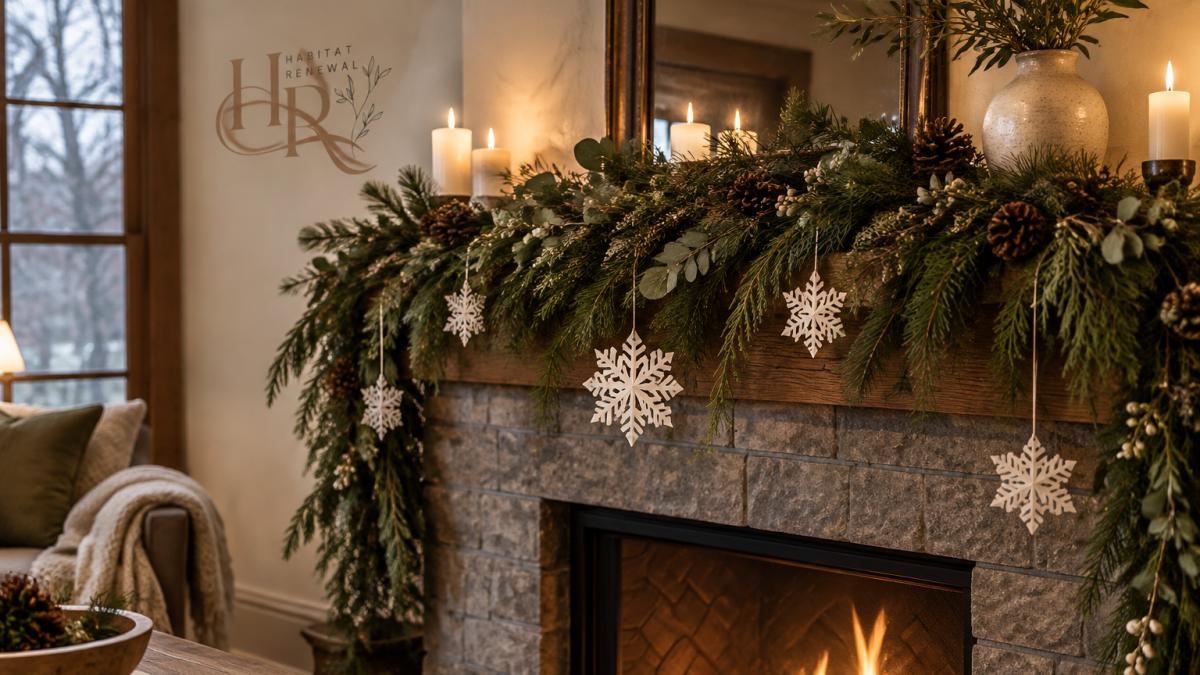
Natural elements bring the calm. Real or faux greenery, berries, wood, and paper all add texture that plastic decorations cannot match.
Our 60" green velvet garland with gold bells suits a mantel or doorway, and the deluxe pine and berry wreath works on a door or as a table centerpiece.


Choose Real or Faux by Room, Not by Principle
A practical split most decorators settle into:
- Fresh greenery for the entryway, mantel, and dining table, places where scent and drape matter and where the greenery is replaced or refreshed within a few weeks.
- Faux greenery for high shelves, stair rails, and anywhere the piece needs to last the full season or be stored and reused.
- Mixed arrangements for the tree itself, where a faux tree with real sprigs tucked into the branches reads fuller than either alone.
Garlands, Wreaths, and Mantel Styling
Layer a mantel in three steps. Start with greenery as the base. Add height with candles or a vase on one side. Finish with small ornaments tucked into the branches.
Keep the arrangement off-center. Symmetry looks stiff; a slight lean feels collected. And check that greenery clears any heat source before you light a fire.
Fire, Electrical, and Pet Safety
Greenery and lights are the two most common sources of holiday decorating injuries and home fires, and the fixes are simple:
- Keep fresh greenery at least three feet from fireplaces, space heaters, and candles. Fresh evergreen dries quickly and ignites readily once dry.
- Check light strands before hanging. Discard any strand with cracked insulation, loose sockets, or a plug that feels warm. Look for a recognized testing laboratory mark (such as UL) on light sets and extension cords.
- Do not overload outlets. Follow the manufacturer's limit on how many strands can be connected end to end; the number is printed on the packaging and varies by set.
- **Use battery-operated candles in arrangements with dried greenery, paper, or fabric. Open flames and dry material are the pairing to avoid.
Watch out: a fresh wreath on a door that gets direct afternoon sun can dry out in days and drop needles onto the threshold, so check it weekly and mist the back if it starts to shed.
Shop the Habitat Renewal Holiday Collection
The easiest way to decorate calmly is to start with fewer, better pieces. Habitat Renewal offers a curated selection of artisan-made decor. Shipping is free on orders over $100.
Your home does not need more decorations this season. It needs the right ones. Habitat Renewal offers globally and locally sourced artisan decor, handcrafted pieces with real stories, and a curated selection of textiles, furniture, and accents.
Frequently Asked Questions
How do you start decorating for the holidays without feeling overwhelmed?
Pick one focal point first, usually the mantel, entryway, or tree, and decorate only that area before moving on. Choose a two- or three-color palette so every piece you add already coordinates. Work from a short timeline: declutter and clean one weekend, hang greenery the next, then add ornaments and accents last. Starting small keeps holiday decorating calm instead of chaotic, and you can always add more once the base looks right.
How can you decorate a small space for the holidays?
Small-space holiday decorating works best when you go vertical and choose pieces that store flat. Hang a wreath on the door or a wall instead of filling floor space, drape a 6-foot garland along a shelf or railing, and use lightweight ornaments that pack into one box. Skip oversized statement trees in favor of a tabletop tree or a swag above a doorway. Renters should favor hanging loops and removable hooks over nails so nothing damages the walls.
How do you make holiday decorations look cohesive?
Cohesion comes from repetition, not volume. Repeat two or three materials across the room, such as green garland, white paper ornaments, and gold accents, and keep the same holiday decorating color scheme from the entryway to the mantel. Give each surface one focal point and leave empty space around it. Handcrafted pieces like a velvet garland with gold bells or sculpted snowflake ornaments tie a room together because their textures echo each other rather than competing.
How can you decorate for the holidays on a budget?
A 2-pack of artificial Norfolk pine garlands is $28, and white paper pulp snowflake ornaments are $10 each, so you can build a set gradually. Mix in natural elements you already have, like pinecones, dried citrus, or branches from the yard. Reuse the same base greenery every year and change only small accents, which keeps holiday decorating affordable without looking sparse.


