


Table of Contents
- What Counts as Artisan Decor (and What Doesn't)
- Step 1: Pick a Dominant Palette Before You Buy Anything
- Step 2: Balancing Textures in Interior Design Without Visual Chaos
- Step 3: How to Style Artisan Home Accents on Shelves, Tables, and Mantels
- Step 4: Choosing Luxury Living Room Furniture That Anchors the Mix
- Step 5: Room-by-Room Applications for an Eclectic Artisan Decor Style
- Step 6: Where to Source Artisan Pieces on a Real Budget
- Common Mistakes That Make Artisan Decor Look Cluttered
- Frequently Asked Questions
Last Updated: September 27, 2026
What Counts as Artisan Decor (and What Doesn't)
Learning how to mix artisan decor styles starts with knowing what you're actually mixing. Artisan decor is home decor made or finished by hand, where the maker's work shows in the grain, the glaze, or the stitch. This guide from Habitat Renewal walks through six steps that pull mismatched pieces into one calm, collected room.
The word gets stretched thin. A factory can print "handcrafted" on a box and call it a day.
So here's the filter I use: can you see the maker's hand in it? If yes, it counts.
- Handmade pieces: thrown, carved, woven, or inlaid by one maker or a small workshop
- Hand-finished pieces: machine-made base, finished by hand (glazing, distressing, waxing)
- Not artisan: mass-produced items with a rustic print or a fake patina
Both handmade and hand-finished pieces can live in your home. Just don't pay handmade prices for a hand-finished story.
Handmade vs. Hand-Finished: A Quick Reality Check
Ask one question before you buy: who touched this last, and how much did they change?
A hand-finished piece is often a smart buy. You get the texture and warmth without the full price tag. A handmade piece is worth the extra when the craft is the point, like a marquetry box with a pattern no machine would bother with.
Step 1: Pick a Dominant Palette Before You Buy Anything
Choose one dominant palette, then let every new piece earn its place against it. A neutral base does the heavy lifting here. Think warm white, oatmeal, clay, or soft charcoal.
This is the step most people skip, and it's why their rooms feel loud instead of layered.
Here's how to lock it in:
- Pick two neutrals for walls, upholstery, and rugs.
- Add one accent color you actually love.
- Allow one wildcard tone in small doses.
That's it. Three decisions, made once.
The basics of color theory from the Smithsonian's Cooper Hewitt design museum explain why this works: contrast reads as intentional when the base stays quiet. Your artisan pieces then pop instead of compete.
Step 2: Balancing Textures in Interior Design Without Visual Chaos
Balancing textures in interior design means giving each material a different job. One texture leads, one supports, one surprises. When every surface is rough, woven, and chunky, nothing stands out.
Natural materials make this easy. Wood, clay, linen, wool, and stone all carry their own visual weight. Your job is to spread that weight around the room.
Try this mix:
- Smooth: glass, glazed ceramic, polished wood
- Rough: raw wood, stone, hammered metal
- Soft: linen, wool, cotton, jute
- Shiny: brass, enamel, mirrored accents
Aim for two or three per surface, not all four.
The thing nobody tells you about texture is that lighting changes it. A rough wall reads soft in lamplight and harsh in direct sun. Test your mix at night before you commit.
Marquet Handmade Resin & Wood →
Step 3: How to Style Artisan Home Accents on Shelves, Tables, and Mantels
Styling artisan home accents works best in odd-numbered groups with one clear focal point per surface. Pick the piece you want people to notice first, then build around it with quieter objects.
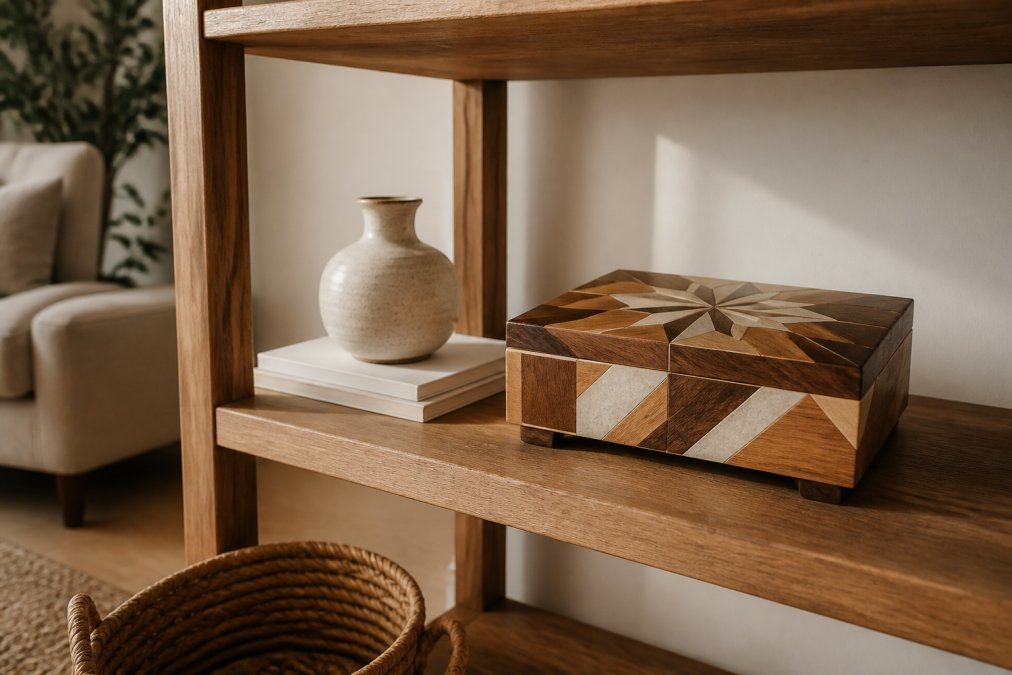
Start with height. A tall vase, a stack of books, or a leaning frame gives the eye somewhere to land. Then add a low, wide piece to anchor the base. Finish with something small and personal, like a handmade box or a candle.
One rule saves most shelves: leave empty space. A shelf that's 70% filled looks curated. A shelf that's 100% filled looks like storage.
For a piece that does both jobs, the Marquet Handmade Resin & Wood Decorative Boxes come in eight sizes.

The 3-5-7 Rule and Other Placement Shortcuts
The 3-5-7 rule says to group objects in odd numbers, and it works because odd counts stop the eye from pairing things up. Use three items on a small shelf, five on a console, seven on a large mantel.
Two more shortcuts:
- Vary height by at least 2 inches between items.
- Repeat one material three times across the room to tie zones together.
Step 4: Choosing Luxury Living Room Furniture That Anchors the Mix
Luxury living room furniture should be the calmest thing in the room. When your accents are busy, your sofa, chairs, and tables need to hold still. That's the whole trick.
Then let the small stuff do the talking:
- Keep upholstery in your two neutral tones
- Add one artisan textile, like a hand-blocked throw or a woven cushion
- Choose wood tones that repeat elsewhere in the room
Step 5: Room-by-Room Applications for an Eclectic Artisan Decor Style
An eclectic artisan decor style looks different in every room, because each room has a different job. The mix stays the same; the volume changes. But the real trick is understanding why certain combinations feel right in one space and chaotic in another. It comes down to the psychology of the room's function.
Bedroom, Entryway, and Dining Nook Examples
Notice the pattern? Each room gets one hero piece, one texture story, and one place to put things down. That's the whole formula. But the deeper principle is that artisan decor in an eclectic mix works when it respects the room's emotional job. A bedroom that feels like a showroom never feels restful. An entryway that feels like a museum never feels welcoming.
Step 6: Where to Source Artisan Pieces on a Real Budget
Sourcing artisan pieces on a budget comes down to timing, priorities, and knowing where the real value hides. Most guides point you to high-end galleries or custom commissions. That's not realistic for most homes. The better approach is to treat sourcing like a treasure hunt, not a shopping trip.
Where to look:
- Local craft fairs and maker markets for ceramics and textiles. Go on the last day. Makers often discount pieces they don't want to pack up.
- Estate sales for solid wood furniture at a fraction of retail. The best finds are often in the garage, not the living room.
- Small-batch online shops that name their makers. If the shop can't tell you who made it, it's not artisan.
- Direct-from-artisan platforms for one-of-a-kind pieces. These often cost less than retail because there's no middleman.
- Thrift stores in wealthy neighborhoods for hand-finished pieces that still have life left.
Common Mistakes That Make Artisan Decor Look Cluttered
Cluttered artisan decor usually comes from one of four mistakes, and all four are fixable in an afternoon. Here's the short list.
| Mistake | The Fix | Why It Works |
|---|---|---|
| Too many focal points | One hero per surface | Gives the eye a place to rest |
| All rough textures | Add one smooth or shiny piece | Creates contrast and depth |
| Matching everything | Mix eras and materials | Builds a collected look |
| Filling every surface | Leave 30% empty | Makes the room feel curated |
Frequently Asked Questions
What is the 3-5-7 rule in decorating?
The 3-5-7 rule is a placement guideline for grouping objects in odd numbers: three items for a small vignette, five for a medium surface, and seven for a large display like a console or mantel. Odd numbers create visual tension that feels more natural than even pairings. When mixing artisan decor, use it to arrange a handcrafted box, a candle, and a small sculpture together, then build outward as the surface gets larger.
How do you mix different textures in artisan decor?
Start with one smooth, quiet base such as a linen sofa or cotton rug, then layer in two or three contrasting textures like raw wood, glazed ceramic, wool, or woven jute. Keep the palette tight so the texture does the talking. A handcrafted resin and wood inlay box on a rough oak console adds contrast without noise. Aim for one smooth surface, one rough surface, and one soft textile in every grouping.
How can I combine traditional artisan crafts with modern furniture?
Balance visual weight by letting one style dominate about 70 percent of the room and the other about 30 percent. Put a clean-lined modern sofa in a neutral base color, then add traditional artisan pieces like hand-blocked textiles, carved wood, or marquetry boxes as accents. Repeat one color or material in both styles so the eye has something to connect. This 70/30 split keeps the room cohesive instead of looking like a showroom.
What are the best ways to display artisan accents in a minimalist space?
Choose fewer pieces and give each one room to breathe. A single handcrafted decorative box on a bare shelf reads as intentional; five competing objects read as clutter. Group no more than three items per surface, vary heights, and leave at least half the surface empty. Rotate pieces seasonally so the display stays fresh without adding more. The goal is one focal point per zone, not a full shelf.


