


Table of Contents
- Start With a Sensory Audit of Your Space
- Calming Home Decor Ideas That Reduce Visual Noise
- Best Color Palettes for Relaxation and Tonal Flow
- How to Declutter for a Calm Home: A Room-by-Room Method
- Layer in Acoustic Comfort and Ergonomic Seating
- Biophilic Design and Indoor Greenery for a Peaceful Atmosphere
- Small-Space Calming Techniques and Budget Adjustments
- Maintain Your Calm Living Spaces With Simple Habits
- Frequently Asked Questions
Last Updated: September 13, 2026
Start With a Sensory Audit of Your Space
Calm living spaces are not built by buying the right sofa. They are built by removing what your senses are quietly fighting all day. This guide from Habitat Renewal walks through a seven-step method, starting with an honest audit.
Most people redecorate when they should be subtracting. A cluttered surface, a flickering bulb, and a chair that hurts your back undo a beautiful room faster than any bad paint color. Before buying anything, spend twenty minutes per room noting what you see, hear, touch, and how your body feels.
A sensory audit is a room-by-room assessment of the sights, sounds, textures, and physical sensations your space produces, used to identify which inputs create stress rather than calm. Stand still and listen for street noise or a humming refrigerator, then sit where you normally sit and notice whether your shoulders drop or tense.
Keep a simple log:
- Loudest sound in the room
- Brightest light source and its direction
- Number of visible objects on open surfaces
- The one seat you avoid because it is uncomfortable
- The spot where you always drop your keys and mail
That last item matters: drop zones become visual noise, the enemy of a peaceful atmosphere.
Calming Home Decor Ideas That Reduce Visual Noise
The fastest calming home decor ideas are subtractive: fewer objects, fewer competing patterns, fewer hard edges. Aim for spatial flow, the eye should travel around a room without snagging.
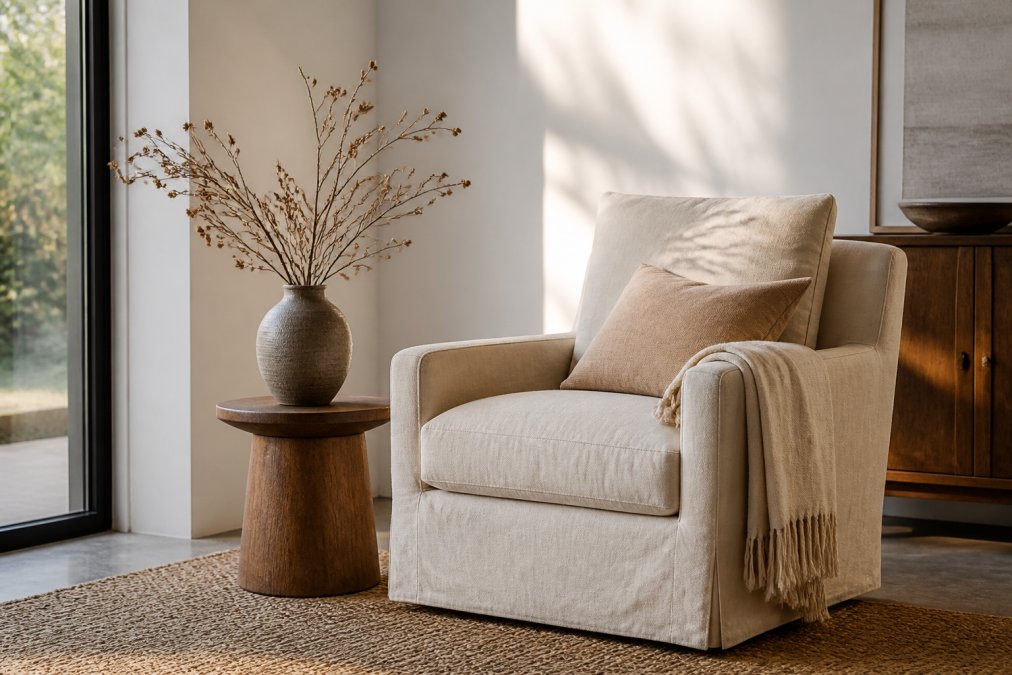
Clear every open surface down to one or two objects, a coffee table with a single ceramic bowl reads calmer than one with five candles, three books, and a remote. Then address pattern: mixing a floral sofa, geometric rug, and striped throw creates visual noise even when each piece is lovely. Pick one pattern and let everything else be solid.
The American Society of Interior Designers' resources on design and well-being note that material and light choices shape how a room feels, not just how it looks. That is the thread running through this whole guide: calm is a sensory outcome, not a style.
Soft Textures and Natural Materials
Texture does the emotional work color cannot. Linen upholstery, wool throws, raw wood, and unglazed ceramics absorb light and soften sound, which is why rooms full of natural materials feel quieter at the same volume.
Texture is infrastructure, not decoration. A boucle or linen armchair changes how a room sounds and feels to sit in. Habitat Renewal's collection leans on handcrafted pieces because artisan-made textiles carry irregular, human texture that mass-produced surfaces flatten out.
Ambient Lighting and Warm Light
Replace one bright overhead light with three smaller sources at different heights. Ambient lighting mimics outdoor light: soft, layered, and directional rather than uniform and glaring.
Warm light, roughly in the range of a candle to a sunset, tells your body the day is winding down; cool-white light does the opposite. If you change one thing this month, change the bulbs in the rooms where you relax.
Best Color Palettes for Relaxation and Tonal Flow
The best color palettes for relaxation are built from a narrow range of neutral tones rather than a single "calming color." Tonal palettes, where every shade sits close to its neighbors on the color wheel, create continuity the eye reads as rest.
Why Color Affects How a Room Feels
Color reaches the brain through two pathways. The first is visual: your eyes send signals to the visual cortex, where you register "sage green" or "clay." The second is older and faster: a separate bundle of nerve fibers carries light straight to the hypothalamus, which governs sleep, appetite, body temperature, and the stress response. That pathway responds to wavelength and intensity, not color names.
This is why a saturated red wall can raise your heart rate even if you find red cheerful, and why soft, warm, low-contrast tones slow your breathing before you decide the room is pleasant. Choose colors low in saturation and close in value, because high-contrast combinations keep the alerting pathway engaged.
Warm Versus Cool Neutrals
Warm neutrals, oatmeal, clay, warm gray, cream, soft sage, sit on the red-yellow side of the color wheel and read as enveloping. Cool neutrals, blue-gray, icy white, charcoal, read as crisp and can feel clinical in low light. For rooms where you rest, warm neutrals are the safer default: a cool gray that looks elegant in a sunlit showroom can turn flat and chilly in a north-facing bedroom.
A useful test: hold a paint chip against white paper in the actual room at the hour you use it most. Warm neutrals look slightly yellow or pink; cool neutrals look slightly blue or green. Trust your own light, not the store's.
The 60-30-10 Rule for Calm Living Spaces
The 60-30-10 rule is a proportion guide: 60 percent dominant tone, 30 percent secondary, 10 percent accent. For calm living spaces, keep the accent muted and the dominant and secondary tones within a few steps of each other in value.
| Layer | Share | Example | Why It Calms |
|---|---|---|---|
| Dominant | 60% | Warm off-white walls, oatmeal sofa | Sets a low-contrast base |
| Secondary | 30% | Clay rug, walnut furniture | Adds depth without jolt |
| Accent | 10% | Sage cushion, brass lamp | Gives the eye one resting point |
Apply the rule to walls, upholstery, and floor coverings first. Accessories come last and should never exceed that final tenth.
How to Declutter for a Calm Home: A Room-by-Room Method
Learning how to declutter for a calm home works best as a sequence, not a single purge: one room at a time, finished before starting the next. But first, understand why clutter is not just visual, it is cognitive, and that changes how you approach the work.
Why Clutter Keeps Your Brain Alert
Every visible object on a surface is a small, unfinished decision. The unopened mail, the charger you might need, the unwrapped gift, each is a task your brain holds open. Attention researchers call this a load on working memory: the mind can only hold so many open loops before it strains. A cluttered room is a room full of open loops.
That is why clearing a surface produces relief out of proportion to the effort: you are closing loops, not just tidying. It also explains why decluttering fails as a one-time event, new loops accumulate the moment you stop paying attention, and the room drifts back toward noise.
A Room-by-Room Sequence
- Entryway: Clear the drop zone, one tray for keys, one hook per person, nothing else. Do it first; it sets the tone.
- Living room: Empty open surfaces, then put back only what you used in the last week. Be honest about "used" versus "might use."
- Kitchen counters: Keep only daily-use appliances out. Everything else goes in a cabinet, even if inconvenient, the inconvenience forces a decision each time.
- Bedroom: Clear the nightstand to a lamp and one object. Nothing under the bed you have not touched in a year. The payoff is largest here, because clutter interferes with sleep.
- Bathroom: One product per category on the counter; the rest in a drawer or bin.
Work in this order: the entryway and living room are the rooms you see most often, and early wins build momentum for the rest.
Keeping It Clear: The Maintenance Habit
Decluttering is a skill you practice, not a project you finish. The most effective habit is a ten-minute evening reset returning every object to its place. Surfaces cleared at night are surfaces you enjoy in the morning, and the habit costs less than the weekly deep clean it replaces.
Pair the reset with a one-in, one-out rule: when a new object enters a room, one leaves. This keeps visual noise from creeping back without another purge. Start with the fastest-accumulating categories, mail, cables, small decor, and let the habit spread.
Layer in Acoustic Comfort and Ergonomic Seating
Acoustic comfort and ergonomic seating are the most overlooked elements of a calm room, and the two your body notices most. A space can look perfect and still feel tense if it echoes and the chair hurts.
Soundproofing a whole home is expensive; softening one room is not. Heavy draperies, a wool rug with a felt pad, upholstered furniture, and foam tiles behind a bookshelf all absorb reflected sound (Document Display (PURL) | NSCEP). The goal is not silence but removing the sharp echo that keeps your nervous system alert.
Seating deserves the same scrutiny. A chair you sink into and cannot rise from comfortably is not restful, however good it looks. Test lumbar support, seat depth, and arm height before committing. If you work from home, an ergonomic seat in your main living space does more for daily calm than any decorative change.
Biophilic Design and Indoor Greenery for a Peaceful Atmosphere
Biophilic design, connecting indoor spaces to natural elements, is one of the most reliable routes to a peaceful atmosphere. It works through light, plants, natural materials, and views, not a single purchase.
You do not need a jungle. Three to five plants where you actually see them will shift how a room feels. Choose low-maintenance varieties if you travel or forget to water: snake plant, pothos, and ZZ plant tolerate neglect well. Pair them with existing natural materials, wood, stone, linen, so the greenery reads as part of the design.
The U.S. Environmental Protection Agency's guidance on indoor air quality is a useful starting point if you want to understand how ventilation and indoor environments affect how a home feels day to day.
Small-Space Calming Techniques and Budget Adjustments
Small rooms and tight budgets are not barriers to calm. They usually respond faster than large rooms, because fewer square feet means fewer inputs to manage.
For small spaces, use these techniques:
- Define zones with a jute rug rather than a wall or divider. A rug under a reading chair creates a room within a room.
- Go vertical with light. A floor lamp and a wall sconce free up surface space and layer the lighting.
- Choose one large piece over several small ones. A single well-proportioned chair reads calmer than three small ones.
- Use a mirror opposite a window to double natural light without adding fixtures.
Budget-friendly sensory adjustments cost little and change a lot: swap cool bulbs for warm ones, add a wool throw to your most-used chair, hang heavy draperies over the noisiest window, put a felt pad under the rug you own. None require new furniture, and together they address light, sound, and touch at once.
Maintain Your Calm Living Spaces With Simple Habits
Calm living spaces stay calm through small routines, not annual overhauls. The room you reset nightly feels different from the room you reset once a season.
Build three habits:
- The ten-minute evening reset. Return every object to its place before bed.
- The one-in, one-out rule. When a new object enters the living room, one leaves.
- The seasonal light check. Adjust lamps and draperies as daylight shifts; a room tuned for summer light often feels dim and cold by November.
If you want pieces that support this kind of maintenance rather than fight it, Habitat Renewal curates handcrafted furniture, textiles, and accents chosen for warmth and durability. Every item is sourced from artisan makers, so a single well-made piece does the work of several disposable ones, and orders over $100 ship free.
The hard part of creating a calm home is not finding beautiful things but resisting the urge to add more. Start with the sensory audit, subtract before you add, and let texture, warm light, and quiet do the rest.
Habitat Renewal can help you finish the room with pieces that hold up to daily life: globally and locally sourced artisan decor, handcrafted items with real stories behind them, and a curated selection of textiles, furniture, and accents designed to nurture the spirit. Get started with Habitat Renewal and build a home that feels as calm as it looks.
Frequently Asked Questions
What is the 60-30-10 rule for decorating living rooms?
The 60-30-10 rule is a color proportion guideline: 60% of a room in a dominant neutral tone (walls, large furniture), 30% in a secondary complementary color (rugs, upholstery), and 10% in an accent color (pillows, art). For calm living spaces, choose a soft dominant like warm white or oatmeal, a secondary like sage or clay, and a small accent like muted brass or deep navy. This balance prevents visual noise without making the room feel flat.
How can I create a calming space at home without a big budget?
Start with what you already own. Remove one non-essential item from every surface, swap overhead bulbs for warm 2700K lamps, and add a textured throw or secondhand jute rug. These three changes cost little and address the biggest sensory triggers: clutter, harsh light, and hard surfaces. You can also try a screen-free hour in the evening and open a window for fresh air. Small, repeatable adjustments often do more for a peaceful atmosphere than a single expensive purchase.
What colors are best for creating a calm living space?
Warm neutrals like oatmeal, sand, and soft white form the best base for relaxation. Pair them with muted greens, dusty blues, or clay tones for a tonal palette that feels grounded. Avoid high-contrast black-and-white schemes and saturated reds or oranges in large doses. If you love a bolder color, use it as the 10% accent in pillows or art rather than on walls. The goal is a palette that lets your eye rest, not one that demands attention.
How does artisan decor contribute to a calming home environment?
Handcrafted pieces often carry irregular textures, natural materials, and a story that mass-produced items lack. That tactile quality gives your eye and hands something gentle to rest on, which supports a peaceful atmosphere. A hand-thrown pottery bowl or a handwoven textile also reduces the visual sameness of a room full of identical factory finishes. When you choose artisan decor, you add warmth and meaning, and those emotional anchors help a space feel like a sanctuary rather than a showroom.


